# Introducing Project Galapago
Please review Disclaimer: Risk of Using Protocol and Terms of Service before using Project Galapago and/or interacting with Project Galapago's services.
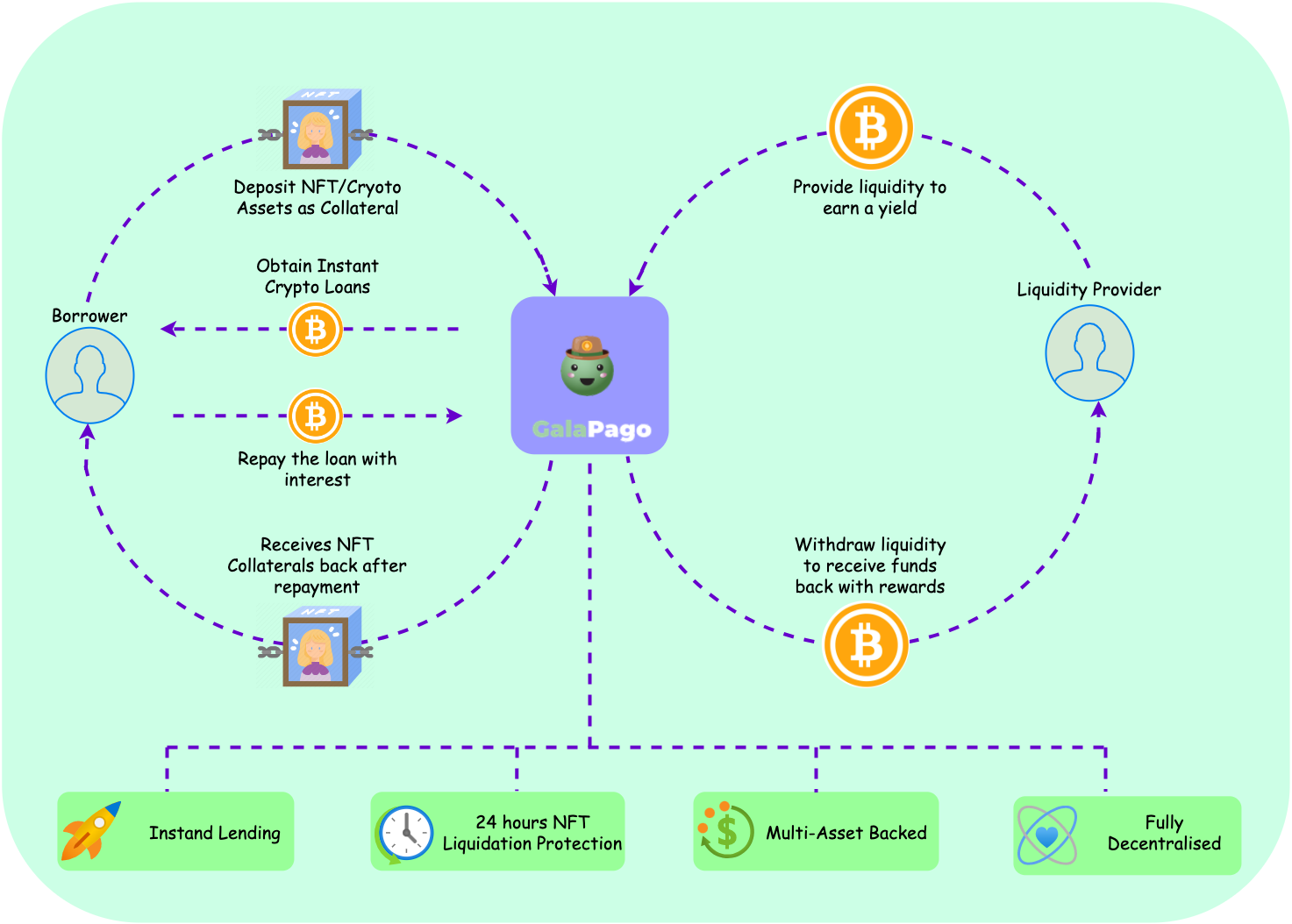
Project Galapago is a fully decentralised, non-custodian NFT and crypto lending protocol. Project Galapago allows user to borrow and lend against both fungible crypto tokens and NFTs instantly using [peer to contract](/how-to/borrow-nft-holder) mechanism. This provides crypto and NFT users maximum flexibility in getting liquidity in their most preferred way.
NFT and crypto investors and holders can obtain liquidity by participate in the protocol as depositors, borrowers or renters.
* **Depositor** enjoys high staking yields by providing liquidity to the lending pool (in peer to contract loans) or lend directly to borrowers to earn interests (in peer to peer loans).
* **Borrower** enjoys the fast instant lending capability from the lending pool to increase funds efficiency against their NFT and crypto assets.
* [**Renter**](broken://pages/Hv8iQCxHvR8CAck8AWQL) enjoys the benefits of the NFT during the leasing period in the scenario when NFT represents a membership or a digital pass.
### Protocol Overview
Protocol Overview
# Disclaimer: Risks of using Project Galapago
Project Galapago is a novel, decentralized NFT finance protocol that allows users to deposit assets and borrow crypto tokens against them. Project Galapago protocol is made up of both proprietary and free, public, and open-source software.Your use of Project Galapago involves various risks, including, but not limited, to losses while digital assets are deposited into Project Galapago via smart contract or economic exploits, and losses due to liquidations and redemptions. Before borrowing, staking, or liquidity providing you should fully review our technical documentation to understand how the Project Galapago protocol works.
USE AT YOUR OWN RISK: THE PROJECT GALAPAGO PROTOCOL IS PROVIDED “AS IS”, WITHOUT WARRANTIES OF ANY KIND. No developer or entity involved in creating the PROJECT GALAPAGO will be liable for any claims or damages whatsoever associated with your use, inability to use, or your interaction with other users of the PROJECT GALAPAGO protocol, including any direct, indirect, incidental, special, exemplary, punitive or consequential damages, or loss of profits, cryptocurrencies, tokens, or anything else of value. PROJECT GALAPAGO reserves the right to modify the terms of the PROJECT GALAPAGO protocol at any time for any reason.
# Connect Wallet
## Install a Web3 wallet on your devices
Project Galapago works on the Algorand blockchain, to interact with the site you will need a Web3 wallet that supports Algorand. If your cryptocurrency is stored on a centralized exchange (such as Coinbase, Binance, and others), it does not count as a Web3 wallet, and will not work.
### Connect your Web3 wallet
You can easily find the “Connect wallet” button on the landing page.
{% embed url="" %}
User Interface might be different to most recent version of app due to UI change.
{% endembed %}
1. Click “Connect wallet”
2. Select a wallet you wish to connect with (e.g. Pera Wallet)
3. Approve the connection from your wallet to app.galapago.app
# Deposit (Lender)
The deposit operation allows the user to lend out their liquidity for protocol loan operation. In return, deposit user receives deposit APR.
{% embed url="" %}
1. Click “Deposit ALGO”
2. Approve ALGO
3. Enter the ALGO amount and Deposit
# Mint NFTs
Mint NFTs instantly for Testnet campaign participation in case you don't have any existing Algorand Testnet NFTs for borrowing to create a loan.
{% embed url="" %}
User Interface might be different to most recent version of app due to UI change.
{% endembed %}
[1.1. Connect your wallet](/connect-wallet)
[1.2. Click “Mint”](#1.2.-click-mint-from-menu-nft)
[1.3. Fill in all required information and Submit](#1.3.-fill-in-all-required-information)
[1.4. Approve the transactions](#1.4.-approve-the-transactions)
[1.5. Finish](#1.5.-finish)
### 1.2. Click “Mint” from menu “NFT”

### 1.3. Fill in all required information
* Upload the image asset, ensure image file name is less than 28 characters.
* Enter all mandatory fields filled with information. Ensure selecting the correct Blockchain (Algorand is selected by default).
* Click “Submit” button to proceed.

### 1.4. Approve the transactions
Once you have hit the Submit button, this will trigger actions of for signing.
Confirm the transactions from your connected wallet.

### 1.5. Finish
Upon successful NFT creation, a successful message will appear.

User will be redirected to the NFT detail screen. Now you are set to kick off a Borrow (loan) transaction.

# Borrow (NFT holder)
Borrow ALGO instantly with your bluechip NFTs.
NFT holders can borrow and repay ALGO anytime. We are in the process of assessing collections as collaterals for Mainnet based on our [whitelisting criteria](/nft-collections-whitelist).
Testnet supports any collections as collateral.
{% embed url="" %}
User Interface might be different to most recent version of app due to UI change.
{% endembed %}
[1.1. Connect your wallet](/connect-wallet)
[1.2. Mint an NFT for Testnet run](/how-to/mint-nfts) (if you do not have a Testnet NFT handy)
[1.3. Click “Borrow”](#1.3.-click-borrow-from-menu-nft-or-click-borrow-algo-from-dashboard)
[1.4. Select an NFT or NFTs as collateral](#1.4.-select-an-nft-or-nfts-as-collateral)
[1.5. Supply Token as collateral (Optional)](#1.5.-supply-token-as-collateral-optional)
[1.6. Enter the borrowed amount](#1.6.-enter-the-borrowed-amount)
[1.7. Approve the transactions](#1.7.-approve-the-transactions)
[1.8. Finish](#1.8.-finish)
### 1.3. Click “Borrow” from Menu “NFT” or click “Borrow ALGO” from dashboard

### 1.4. Select an NFT or NFTs as collateral
Select the NFT or NFTs to be taken as collateral for the loans, and hit “Next” button.

### 1.5. Supply Token as collateral (Optional)
Galapago protocol is also supporting Borrow (loan) with token as collateral. User can effectively take their entire wallet portfolio (FTs and NFTs) to start borrowing with us.
Galapago protocol is currently supporting USDC stable coin (Testnet Asset ID: 10458941) as collateral.

### 1.6. Enter the borrowed amount
Drag the percentage bar to select borrowed amount and click Next.

* Total Price: Indicates the sum of current floor price of NFTs and collateralized token price, provided by Algorand blue chip NFT price oracle. Testnet price feed might not be accurate.
* Utilization rate: Indicates the utilization rate of ALGO liquidity pool, which determines the dynamic interest rate for depositing and borrowing. For more information, please refer to our [interest model page](/interest-rate-model).
* Available to borrow: Indicates the maximum amount that can be borrowed, Available to borrow amount = floor price \* collateral rate. Check the [collateral rates](/risk-parameters) for NFTs and FTs.
* Borrow Rate: The APR rate that represents the interest to be paid during the borrowing period, which is affected by the Utilization rate.
### 1.7. Approve the transactions
Click on Borrow button and follow the prompts to proceed.

Approve transactions with your connected wallet.

### 1.8. Finish
You can verify your loan items via "My Borrows" in menu item or dashboard.

# Repay a Loan
After borrowing funds from a lending pool in Project Galapago,there is no loan due date on the loans. You can repay any amount to keep your loan Health Factor above 1 to avoid getting liquidated by auction. Here's how you can repay a loan in Project Galapago:
[1.1. Connect wallet](/connect-wallet)
[1.2. Check your loan details](#1.2.-check-your-loan-details)
[1.3. Repay your loan](#1.3.-repay-your-loan)
[1.4. Verify your loan status](#1.4.-verify-your-loan-status)
### 1.2. Check your loan details
Before making a repayment, it's important to review your loan details to ensure that you are aware of the amount that you owe, the interest rate, and the repayment deadline. You can find all of this information in the "Dashboard" section.
### 1.3. Repay your loan
Once you have reviewed the loan information, you can proceed to repay your loan. To do this, follow these steps:
1. Navigate to the "Repay" page.
2. Click the “Repay” on the NFT to be repaid to start repayment
3. Enter the total repayment amount.
4. Confirm the repayment transaction.
Below are the descriptions for the repay operations:
* Repay a part of your loan: Increase health factor to reduce liquidation risk
* Full repayment: You will redeem your NFT.
* Your debt: Current outstanding loan
* Remaining debt: If you choose to repay a part of the loan, the debt balance after repayment
* Collateral ratio: Current NFT's collateral ratio
* Liquidation price: The current liquidation price of NFT
* The new health factor: If you choose partial repayment, the health value will be adjusted according to the repayment amount.
Once the repayment transaction is confirmed, the funds will be automatically transferred from your wallet to the lending pool's wallet, and your loan will be marked as repaid.
### 1.4. Verify your loan status
After repaying your loan, it's important to verify that your health factor has been updated . You should also check your wallet balance to ensure that the repayment transaction was processed successfully.
That's it! By following these simple steps, you can repay your loan in Project Galapago and avoid any potential liquidation of your NFTs.
# Portfolio Lending
The Portfolio Lending System is an innovative mechanism that transforms the traditional isolated margin pool into a cross-margin system. This system allows for a more efficient and flexible use of collateral, including both fungible tokens and NFTs. Each type of collateral is assigned a credit line, which can be used to provide loans across all types of collateral.
The system calculates a health coefficient for the entire portfolio of staked assets. As long as this coefficient remains above 1, no liquidation auction will be triggered for the staked NFTs.
### Limitations of Traditional Deposit Pool Design
In the traditional isolated margin pool design, the process of staking multiple assets and managing loans can be cumbersome. For instance, if a user wants to stake 5 blue chip NFTs to borrow ALGO for purchasing other NFTs, they would need to conduct 5 separate on-chain transactions and manage 5 different loan positions. This design not only increases operational complexity but also limits flexibility in managing liquidation risks.
### Advantages of Project Galapago's Portfolio Limit Design
Project Galapago's portfolio limit design addresses these issues by allowing users to deposit additional collateral (either NFTs or fungible tokens) to maintain a high health factor, thereby avoiding liquidation. Each type of collateral supported by Project Galapago is assigned a total value, which contributes to the overall health factor of the portfolio.
One of the key benefits of the cross-margin model is its ability to hedge risks. If a user's NFT portfolio contains assets with negative price correlations, it can mitigate the risk of liquidation due to sudden price changes in a single asset. This concept is similar to contract account positions in traditional trading. Through cross-margin, traders can use fewer funds to trade, achieve higher leverage ratios, and potentially earn higher returns in the market.
# Lending Pool
Lending Pool is a crucial component of Project Galapago. It's a smart contract that aggregates users' deposits and manages users' borrowings for a specific asset. Each asset supported by Project Galapago has its unique LendingPool. The interaction between depositors and borrowers within a pool creates a dynamic ecosystem that regulates itself based on the utilization of the pool.
### Utilization Ratio
The utilization ratio ($$U$$) of a pool is defined as the ratio between the total borrowed amount and the total deposited amount in the pool:
$$
U=\frac {Total Borrowed Amount} {Total Deposited Amount}
$$
The protocol leverages $$U$$ to maintain balance in the pool between deposits and loans. The utilization ratio plays a critical role in determining the interest rates for depositors and borrowers, and in ensuring that the pool remains sustainable and liquid.
* When $$U$$is high, it indicates that the pool has a high borrowing relative to the deposits. This situation reduces the available liquidity, which could pose problems if many depositors decide to withdraw their funds simultaneously. To mitigate this, the protocol increases the borrowing interest rate, and consequently, the deposit interest rate. This approach discourages new loans while incentivizing new deposits, thereby restoring liquidity to the pool.
* Conversely, when $$U$$ is low, it implies that there is excess liquidity in the pool. In this case, the protocol decreases the borrowing interest rate, and consequently, the deposit interest rate. This action incentivizes new borrowings and discourages further deposits, thereby ensuring the efficient utilization of the pool's assets.
This automatic adjustment of interest rates based on the utilization ratio ensures that the pool remains sustainable and attractive for both depositors and borrowers. It enables the protocol to balance the needs of depositors for returns on their deposits and borrowers for affordable interest rates on their loans. This system also ensures that the liquidity of the pool is always maintained, protecting the interests of all users of the protocol.
# Interest Rate Model
The interest rates charged to borrowers in Project Galapago are not static; they are dynamic and depend on the pool's Utilization Rate ($$U$$). This dynamic interest model is designed to promote liquidity within the pool.
When there is an abundance of capital (low $$U$$), borrowers pay less interest to incentivize borrowings. However, when capital becomes scarce (high $$U$$), interest rates increase to encourage more deposits and prompt borrowers to repay their loans, thereby replenishing the pool's liquidity.
The mechanism also accounts for liquidity risk. As $$U$$ approaches 100%, the liquidity risk increases. To manage this risk, the protocol implements an inflection point ($$Uoptimal$$), beyond which the interest rate slope increases sharply. This inflection point is a crucial part of the interest model, triggering a rapid rise in interest rates when $$U$$ exceeds $$Uoptimal$$ and helping to restore liquidity quickly.
The interest rate model can be represented as:
$$if \hspace{1mm} U < U\_{optimal}: \hspace{1cm} R\_t = R\_0 + \frac{U\_t}{U\_{optimal}} R\_{slope1}$$
$$if \hspace{1mm} U \geq U\_{optimal}: \hspace{1cm} R\_t = R\_0 + R\_{slope1} + \frac{U\_t-U\_{optimal}}{1-U\_{optimal}}R\_{slope2}$$
where $$R\_{slope1}, R\_{slope2}$$ and $$R\_0$$ are parameters that define the slopes and intercepts of the interest rate model, and $$R\_t$$ is the resulting interest rate.
The actual annual percentage yield (APY) can be calculated as:
$$
ActualAPY=(1+ \frac {TheoreticalAPY} {secsperyear})^{secsperyear}−1
$$
This model ensures that the interest rates adapt to the current liquidity conditions, promoting the sustainability of the pool and providing fair returns for depositors and reasonable rates for borrowers. It ensures that the pool remains liquid, reduces risks, and balances the needs of all users of the protocol.
# Risk Parameters
Risk Management Parameters
Each asset in the Galapago Protocol has specific parameters that influences how they can be supplied and borrowed.
* Collateral Factor (CF) or Loan-to-Value (LTV) - What is the maximum amount that can be borrowed? It is represented as a % with numerator equal to Max Amount Borrowed/Value of Supplied Asset Max We will often refer to this value as Collateral Factor and abbreviate as CF.
* Liquidation Threshold (LT) - This represents the point when the asset would start to go through the liquidation process. It is represented as a % with numerator equal to Total Debt/Value of AssetTotal. The difference between the CF and Liquidation Threshold can be considered as the safety cushion for borrowers.
* Liquidation Bonus - The amount of additional collateral that liquidators receive / are discounted for purchasing assets on liquidation. Represented as percentage of the collateral purchased. This provides extra incentives for purchasing through liquidation.
### Collateral Factor
The maximum amount user can borrow is based on the weighted collateral factor--i.e. the value of assets supplied and their corresponding collateral values according to our Asset Risk parameters.
### Liquidation Threshold
For each wallet the Liquidation Threshold is calculate as the weighted average of the Liquidation Thresholds of the collateral assets and their value
### Summary Table
| Asset | Max Collateral Factor | Liquidation Threshold | Liquidation Bonus |
| ---------------------- | --------------------- | --------------------- | ----------------- |
| Algorand Bluechip NFTs | 40% | 70% | 8% |
| ALGO | 65% | 65% | 8% |
| USDC | 80% | 85% | 8% |
| USDT | 80% | 85% | 8% |
| gBTC | 70% | 80% | 8% |
| gETH | 70% | 80% | 8% |
| wBTC | 70% | 80% | 8% |
| wETH | 70% | 80% | 8% |
# Loan Health Factor & Liquidation
Monitor and Manage Protocol Financial Risk
### Loan Health Factor
The liquidation mechanism in Project Galapago is designed to maintain the protocol's financial health. It is activated when a user's Loan Health Factor falls below 1, indicating that the value of their collateral is insufficient to cover their loan. The Loan Health Factor is calculated by dividing the floor price of the collateral (multiplied by the liquidation threshold) by the total value of the loan. When a user's Loan Health Factor falls equal to or below 1, the loan is at risk of being liquidated. The protocol then alerts the Health Factor list, and anyone can trigger an auction against the collateral.
### Fungible Token Liquidations
When the Health Factor for fungible tokens or NFTs falls below 1, assets will be liquidated. The protocol prioritizes liquidating fungible tokens (ALGO and USDC) before NFTs due to their greater liquidity. Liquidators can claim ALGO and USDC tokens before NFTs. These non-NFT collaterals will be used to pay down the overall debt (total borrow + interest owed).
### NFT Liquidation Auction
An NFT auction will be initiated when the health factor is equal to or below 1. More specifically, the loan will be liquidated when the debt value is worth liquidation threshold (e.g. 80%) of the collateral value.
* An open-outcry ascending dynamic auction system
* The system opens the auction with a starting price. The starting price will be greater than the total accumulated debt.
* If the borrowers repay the loan in 8 hours, he/she will pay a fine to the first bidder.
* The fine will be maximum of (5% debt or 1500 ALGO).
### Bidder
* Anyone can take part in an auction.
* The bid must be:1) no less than the starting price; 2) higher than the previous bid plus 1% debt.
* The first bidder will receive at least 1500 ALGO paid by the borrower as the penalty if the borrower repays within 8 hours.
* The highest bidder will get the collateral if the borrower doesn't repay the loan.
* The bidder needs to deposit ALGO to bid.
* The deposited ALGO will automatically be refunded when his/her bid is not the highest bid.
### Borrower
* The borrower will have a liquidation protection period to repay the loan.
* If the borrower repays 50% of the debt within 8 hours, he/she will pay a fine of a maximum(5% of the debt, 1500 ALGO) to the first bidder.
* If the collateral is sold in auction for greater than the loan amount, the excess will belong to the borrower.
# NFT Collections Whitelist
Project Galapago uses NFTs as the collaterals for borrowing which enables NFT holders to be able to actively participate in the DeFi ecosystem. This means that controlling the risks associated with the NFTs such as price fluctuations and manipulations are crucial to reduce the financial risks to the protocol. When assessing which NFT collections are eligible to be whitelisted for instant lending, Project Galapago uses the following NFT Performance Map designed by [nonfungible.com](http://nonfungible.com) with 5 key metrics:
* Trade Volume (Number of sales)
* Asset value (Average asset sales value)
* Interactions (Number of dapp transactions, including bids and other interactions)
* Community (Number of unique wallets interacting at the dapp level)
* Retention (Percentage of how many days a wallet is active in the time period, for example a retention rate of 14.3% indicates that users are only active one day of the week)
Mainnet: We are in the process of assessing whitelisting collections as collaterals.
Testnet: Supports any collections as collaterals.
# Peer to Peer Lending
This page describes the peer to peer lending process
Peer to Peer lending is a future roadmap items.
# Future Roadmap
Galapago protocol sets out a roadmap for feature development & ecosystem collaboration. Community feedback will be assessed and implemented in each release.
Roadmap priority are constantly reviewed and assessed.
### 2023 Q1
* Validation Concept :green\_circle:
* Build Prototype :green\_circle:
* Demo Version Launch :green\_circle:
### 2023 Q2
* Testnet Launch :green\_circle:
* Stable Coins & Wrapped Stable Coins Lending Capability :yellow\_circle:
* BTC, ETH & Wrapped BTC, ETH Lending Capability :yellow\_circle:
* Uniswap V3 LP Tokens Lending Capability
* Pairing Listing Capability
### 2023 Q3
* Mainnet Launch
* NFT Rental
* P2P NFT Lending
* Algorand Ecosystem Partner Collaboration
### 2023 Q4
* DAO
# Contact Us
Join us on below social media channels
* [Twitter](https://twitter.com/ProjectGalapago)
* [Discord](https://discord.com/invite/GD3V6ty3kk)
* [Linkedin](https://www.linkedin.com/company/project-galapago/) 
* [YouTube](https://www.youtube.com/channel/UCPE1gBj4Hmklc4yg84mnhLg)
* [Medium](https://medium.com/@galapago)
# Chinese Version 中文
## 项目简述
Project Galapago 是一个集成“点对点”及“点对池”NFT抵押借贷协议,主要服务于蓝筹NFT持有者。点对池贷款人(点)可通过在协议池(池)中抵押蓝筹NFT快速贷出资金池内加密幣,存款人(点)向资金池(池)提供加密幣,获取以加密幣计价的利息,并且借贷双方均会获得$PAGO挖矿奖励。
除了主要点对池**借贷业务**外,Project Galapago还提供了内置的**交易市场**,支持“点对点”借贷(Peer-to-Peer)功能等。
Project Galapago以蓝筹NFT资产为抵押物借贷加密幣为主要业务,其他业务有Project Galapago上内置的交易市场,支持用户借贷的同时,也支持用户创建和购买NFT。基于以上的业务,协议主要收入来源是抵押借贷产生的息差收入,其他收入还有交易市场带来的交易费用收入(2%费率)和购买手续费收入(1%费率)。
## NFT借贷业务
### **抵押物估值方法**
NFT定价决定了可贷款出资金的基数。Galapago为NFT抵押物的定价通过内置价格计算器实现,将链下的OpenSea和LooksRare等NFT交易市場地板价进行一定清洗处理后,通过预言机喂价给协议,协议在链上采用TWAP(时间加权计算法,Time-Weighted Average Price)计算得出NFT的价值。
采用该种方法的定价使得Project Galapago上对NFT的定价不会过低,也可以降低协议地板价被操纵的风险,从而避免NFT清算被轻易触发,**具有效率高、成本低、抗操纵的优势。**
### **借贷利率 Interest Rate Model**
Project Galapago的借贷利率随池内资金利用率浮动,资金利率用率高时,借贷利率上升刺激存款、抑制贷款,当资金利用率高于45%时,利率上升速率加快,资金利用率低时,借贷利率下降。
协议池资金充足性及抵押物资产质量决定了点对池协议的健康程度,因此Project Galapago的浮动利率机制作为一种自动调节机制,维持协议平衡。
### **清算机制**
Project Galapago协议的清算机制为公开拍卖形式。清算线(Liquidation Threshold)为80%,即当某一负债总额超过协议地板价80%时,其贷款的健康因子低于1,抵押物会进入清算流程。当第一个竞拍者出现后,会启动24小时拍卖流程。Project Galapago采用英式拍卖的方式,起拍价需大于等于贷款的负债本息和,后续竞拍价格需至少按总负债金额1%递增,若贷款人在24小时拍卖期间偿付至少50%负债金额,可以赎回抵押物,但也需要向首个竞拍者支付清算补偿金作为奖励,奖金为300 USDT和5%负债金额之间的较高值;若24小时内贷款人没有进行偿还,则最后竞拍者,也是出价最高者拍得NFT。
#### 健康因子计算公式
健康因子 = (地板价 x 清算线 )/ 负债总额;Health Factor = (Floor Price \* Liquidation Threshold) / Debt with Interests
## **NFT交易市场业务**
Project Galapago内置的NFT交易市场,主要为贷款人和NFT用户提供更多服务,支持NFT用家在借贷的同时创建,购买和销售NFT。
 * [Discord](https://discord.com/invite/GD3V6ty3kk)
  * [Linkedin](https://www.linkedin.com/company/project-galapago/) 
* [YouTube](https://www.youtube.com/channel/UCPE1gBj4Hmklc4yg84mnhLg)
* [Linkedin](https://www.linkedin.com/company/project-galapago/) 
* [YouTube](https://www.youtube.com/channel/UCPE1gBj4Hmklc4yg84mnhLg)  * [Medium](https://medium.com/@galapago)
  # Chinese Version 中文
## 项目简述
Project Galapago 是一个集成“点对点”及“点对池”NFT抵押借贷协议,主要服务于蓝筹NFT持有者。点对池贷款人(点)可通过在协议池(池)中抵押蓝筹NFT快速贷出资金池内加密幣,存款人(点)向资金池(池)提供加密幣,获取以加密幣计价的利息,并且借贷双方均会获得$PAGO挖矿奖励。
除了主要点对池**借贷业务**外,Project Galapago还提供了内置的**交易市场**,支持“点对点”借贷(Peer-to-Peer)功能等。
Project Galapago以蓝筹NFT资产为抵押物借贷加密幣为主要业务,其他业务有Project Galapago上内置的交易市场,支持用户借贷的同时,也支持用户创建和购买NFT。基于以上的业务,协议主要收入来源是抵押借贷产生的息差收入,其他收入还有交易市场带来的交易费用收入(2%费率)和购买手续费收入(1%费率)。
# Chinese Version 中文
## 项目简述
Project Galapago 是一个集成“点对点”及“点对池”NFT抵押借贷协议,主要服务于蓝筹NFT持有者。点对池贷款人(点)可通过在协议池(池)中抵押蓝筹NFT快速贷出资金池内加密幣,存款人(点)向资金池(池)提供加密幣,获取以加密幣计价的利息,并且借贷双方均会获得$PAGO挖矿奖励。
除了主要点对池**借贷业务**外,Project Galapago还提供了内置的**交易市场**,支持“点对点”借贷(Peer-to-Peer)功能等。
Project Galapago以蓝筹NFT资产为抵押物借贷加密幣为主要业务,其他业务有Project Galapago上内置的交易市场,支持用户借贷的同时,也支持用户创建和购买NFT。基于以上的业务,协议主要收入来源是抵押借贷产生的息差收入,其他收入还有交易市场带来的交易费用收入(2%费率)和购买手续费收入(1%费率)。